

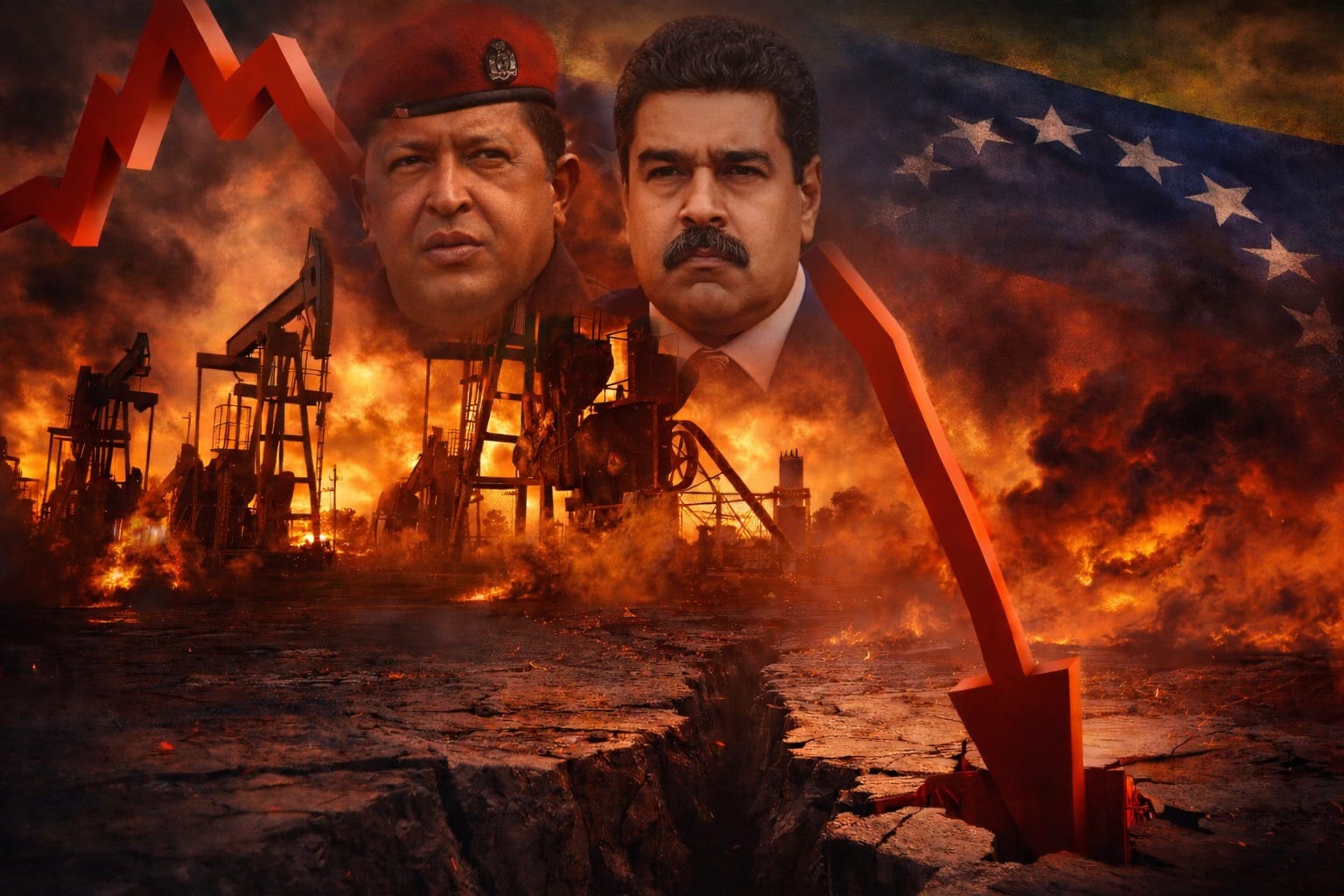
Nearly three decades of expropriations, serial defaults, systemic corruption, and narcotraffickers running a state oil company. This is how Venezuela earned every sanction it received—and why every consequence was inevitable.
Venezuela sits on 303 billion barrels of oil—the largest proven reserves on Earth. More than Saudi Arabia. More than Russia. More than anyone.
Yet today, Venezuela produces less oil than Oman, a desert nation with 5 billion barrels in reserves.
This isn’t a mystery. This isn’t bad luck. And it sure as hell isn’t sanctions. This is what happens when a criminal regime converts a world-class oil company into a systematic looting operation, places internationally sanctioned narcotraffickers in charge of petroleum policy, defaults on $150 billion in debt, and threatens anyone who complains. Every sanction Venezuela faces was earned. Every consequence was inevitable.
HOW CHAVISMO STOLE FROM OIL COMPANIES AND DESTROYED INVESTMENT
Between 2007 and 2012, the chavista regime executed the forced nationalization of petroleum assets valued at over $30 billion. On May 1, 2007, Hugo Chávez appeared on national television and announced the immediate nationalization of the Orinoco Belt projects—the crown jewels of Venezuela’s petroleum sector. ConocoPhillips, ExxonMobil, Chevron, Total, Statoil, and BP had invested billions developing these fields under legally binding contracts. Chávez unilaterally tore up those contracts through presidential decree, offering a brutal choice: accept minority stakes with the government controlling operations, or leave with nothing.
ConocoPhillips and ExxonMobil refused and walked away from billions. The others reluctantly accepted minority positions under threat of total loss. By 2012, Rafael Ramírez—Chávez’s Minister of Petroleum and PDVSA president—had expelled or subordinated every major international partner.
But the wave didn’t stop there. In 2008, Chávez nationalized Cemex and Holcim cement plants. In 2009, he seized oilfield service assets from Schlumberger, Halliburton, and Baker Hughes. In 2011, he expropriated the Las Cristinas gold mine from Crystallex after years of regulatory obstruction.
The regime’s justification: “recovering national sovereignty from Yankee imperialists.” The legal reality: Venezuela had signed bilateral investment treaties guaranteeing protection against expropriation without fair compensation. Chávez violated every single one.
International arbitration tribunals ruled unanimously against Venezuela:
ExxonMobil: $1.6 billion (2014)
Crystallex: $1.4 billion (2016)
ConocoPhillips: $8.7 billion (2019)—the largest arbitration award in history
Venezuela’s response? Refuse to pay. Attack tribunals as “imperialist instruments.” Celebrate non-payment as political victory.
The consequence was immediate: no serious international oil company would invest in Venezuela again. The message was clear—contract with Venezuela, and the State will steal your assets and refuse legal recourse.
PDVSA had always depended on foreign partners. The Orinoco Belt contains extra-heavy crude requiring advanced technology and massive capital that PDVSA never possessed independently. When those partners were expelled, PDVSA was operationally stranded.
The production collapse:
1998: 3.5 million barrels per day (bpd)
2007: 2.6 million bpd
2013: 2.4 million bpd
2017: 1.5 million bpd
2023: 500,000 bpd
That’s an 86% collapse.
Critical timing: The first meaningful U.S. sectoral sanctions came in August 2017, when production had already fallen from 3.5 million to 1.9 million bpd. Venezuela lost 46% of output before any major sanctions. The collapse preceded sanctions by a decade.
HOW CHAVISMO STOPPED PAYING AND LOST ALL CREDIBILITY
On November 2, 2017, Nicolás Maduro announced Venezuela would “restructure” its debt—meaning default. No creditor negotiations. No IMF involvement. Just a declaration that Venezuela would pay “when it can and how it can.”
Economy Minister Simón Zerpa claimed Venezuela prioritized “food and medicine” over “Wall Street bondholders.” But the regime was defaulting while importing luxuries for elites, maintaining $6 billion annually in oil subsidies to Cuba, and funneling billions offshore.
By January 2018, Venezuela had accumulated:
$60+ billion in unpaid sovereign bonds
$23 billion in unpaid PDVSA bonds
$20+ billion in unpaid Chinese loans
$12+ billion in unpaid arbitration awards
$4 billion in unpaid Petrocaribe receivables
Total: Over $150 billion in default.
Even allies got burned. Russia’s Rosneft sold its Venezuelan assets in March 2020 to avoid U.S. sanctions exposure. China cut off new financing after accumulating $20 billion in defaults. When even geopolitical partners bail, you’re radioactive.
Venezuela cannot issue bonds, access credit, or participate in joint ventures with Western firms. The financial isolation is absolute.
The regional comparison:
Brazil: Attracted $100+ billion in petroleum investment (2015-2024). Production: 3.2 million bpd.
Guyana: Discovered oil in 2015 (11 billion barrels—4% of Venezuela’s reserves). Attracted $30+ billion. Production: 400,000 bpd and rising. A country with zero oil production a decade ago now outproduces Venezuela.
Colombia: 2 billion barrels in reserves. Production: 800,000 bpd.
Venezuela: 303 billion barrels—more than all three combined. Production: 500,000 bpd.
The difference has nothing to do with resources. It’s institutions: property rights, contractual certainty, judicial independence. Venezuela destroyed all of them.
HOW PDVSA BECAME CHAVISMO’S PERSONAL ATM
The systematic looting of PDVSA from within destroyed operational capacity from the inside. This was industrial-scale, institutionalized theft conducted as state policy.
According to U.S. Department of Justice investigations, at least $4.5 billion was diverted from PDVSA between 2011 and 2018 through overbilled contracts, fraudulent sales, and money laundering.
The criminals weren’t low-level bureaucrats—they were top officials:
Alejandro Andrade (Chávez’s former bodyguard, National Treasurer): Pleaded guilty in 2018 to receiving over $1 billion in bribes. Spent $50 million on horses, $5 million on watches, $10 million on cars. Now serving 10 years in U.S. federal prison.
Luis Carlos de León Pérez (PDVSA Security Director): Admitted receiving $600 million in bribes.
Nervis Villalobos (Deputy Energy Minister): Arrested in Spain (2021) for laundering $1.2 billion in PDVSA funds.
Diego Salazar (Rafael Ramírez’s cousin): Arrested in Spain (2018) for laundering $2 billion through European real estate.
Rafael Ramírez ran PDVSA from 2004-2014. Under him, the payroll exploded from 40,000 to 150,000 employees while production declined. He’s under investigation in Italy, Andorra, Spain, and the U.S. for illicit enrichment in the hundreds of millions. He lives in exile, beyond justice.
The Odebrecht scandal revealed $98 million in bribes to Venezuelan officials including Eulogio Del Pino (PDVSA president 2014-2017), Luis Motta Domínguez (Energy Minister), and Nelson Martínez (PDVSA president 2017, died mysteriously after arrest).
The bond scheme: In 2014, PDVSA issued $5 billion in bonds. The regime sold them at 70% discounts to connected intermediaries who immediately flipped them. PDVSA received $1.5 billion. The State gave away $3.5 billion. Regime insiders pocketed billions.
This endemic corruption didn’t just destroy PDVSA’s value—it made the company legally untouchable. Under the Foreign Corrupt Practices Act (FCPA) and European anti-bribery laws, Western companies face criminal liability for doing business with systemically corrupt entities. No chief legal officer can approve Venezuelan operations without exposing their company to catastrophic legal risk.
HOW PLACING NARCOTRAFFICKERS IN POWER GUARANTEED SANCTIONS
If corruption wasn’t enough, the regime made things worse: placing internationally sanctioned narcotraffickers in direct control of the oil industry.
On February 13, 2017, the U.S. Treasury designated Tareck El Aissami—then Venezuela’s Executive Vice President—under the Foreign Narcotics Kingpin Designation Act. The same law used against Pablo Escobar and El Chapo. El Aissami was formally accused of facilitating shipment of over 1,000 kilograms of cocaine through Venezuela.
Maduro’s response? Keep him as Vice President. Then, on April 26, 2020, Maduro appointed El Aissami as Minister of Petroleum and PDVSA president.
A DEA-designated narcotrafficker now controlled Venezuela’s state oil company.
The legal consequence was immediate: Any company doing business with PDVSA would be transacting with an OFAC-designated individual—a federal crime under U.S. law. No U.S. company could legally operate. No international company with U.S. exposure could participate without risking secondary sanctions and criminal prosecution.
El Aissami remained Petroleum Minister until January 2023. His tenure coincided with PDVSA’s operational nadir: production fell from 800,000 bpd (April 2020) to less than 400,000 bpd (2021).
Diosdado Cabello, currently Interior Minister, is accused by the DEA of leading the Cartel of the Suns—a narcotrafficking network using PDVSA infrastructure to export cocaine. In March 2020, the U.S. indicted Maduro, Cabello, and other officials on narcoterrorism charges, offering a $10 million reward for Cabello’s arrest.
Delcy Rodríguez (Vice President since 2018, former Foreign Minister) has been identified by investigations as facilitating PDVSA corruption schemes, illegal gold operations, and sanctions evasion through Turkish intermediaries and Iranian barter arrangements. Her brother, Jorge Rodríguez (National Assembly president), serves the same criminal enterprise.
This isn’t normal government behavior. This is a criminal organization controlling state institutions.
When a regime places designated narcotraffickers in charge of petroleum policy, sanctions aren’t aggression—they’re the only rational response.
HOW CHAVISMO THREATENED THE WORLD AND THE WORLD RESPONDED
Chavismo converted threats into official diplomatic language. On February 26, 2008, Chávez threatened to cut oil supply to the U.S.: “If they touch me, the oil to the United States is screwed.” He repeated these threats in 2012.
Maduro escalated. At the 2017 UN General Assembly, he called Trump “the new Hitler” and promised “forceful responses” to sanctions. In January 2019, after international recognition of Juan Guaidó, Maduro broke relations with the U.S. and expelled embassy personnel. Jorge Rodríguez declared: “Venezuela will respond with war if necessary.”
Delcy Rodríguez used international forums to defend Iran, Syria, North Korea, and Russia. In March 2017, Venezuela signed petroleum cooperation agreements with Iran, violating UN Security Council resolutions.
Venezuela provides safe haven to Colombian narco-guerrillas (ELN, FARC dissidents), sends $6 billion annually in oil subsidies to Cuba, and partners with U.S.-designated terrorist organizations.
When a government:
Threatens energy supply disruptions
Partners with sanctioned rogue states
Facilitates narcotrafficking
Hosts terrorist organizations
Places sanctioned criminals in charge of strategic industries
Sanctions aren’t aggression. Sanctions are defense.
The U.S., EU, Canada, Switzerland, and others imposed restrictions because chavismo converted Venezuela into a hemispheric security threat.
EVERYTHING WE LOST IS CHAVISMO’S FAULT
The destruction of PDVSA wasn’t caused by sanctions—it was caused by nearly three decades of expropriations, corruption, incompetence, and international confrontation under Rafael Ramírez, Eulogio Del Pino, Nelson Martínez, Manuel Quevedo, Tareck El Aissami, and Pedro Tellechea.
Sanctions arrived after the collapse, not before. In August 2017, when the first sectoral sanctions hit, production had already fallen 46%. By January 2019, when OFAC directly sanctioned PDVSA, production was already at 1.1 million bpd.
Production fell 90% because the regime:
Expelled all competent foreign partners
Looted billions instead of investing in maintenance
Purged technical expertise for political loyalty
Placed narcotraffickers in operational control
Destroyed all institutional credibility
The destruction came from within.
What we lost:
💰 Economic catastrophe: GDP collapsed 75% (2013-2020). Hyperinflation exceeded 1,000,000% annually. Poverty rate: 94%+.
🏃 Humanitarian crisis: 7+ million Venezuelans fled—largest displacement in hemisphere. Healthcare collapsed. Malnutrition, preventable disease outbreaks.
⚖️ Institutional annihilation: Property rights destroyed. Rule of law eliminated. Judiciary captured. Electoral fraud institutionalized.
🌎 International isolation: Credit markets closed. Investment blacklisted. Diplomatic pariah. Regional destabilization.
All of it—every consequence—traces directly to chavista policy choices.
THE LESSON: ACTIONS HAVE CONSEQUENCES
The regime that expropriates $30 billion in foreign assets doesn’t get to complain when no company ever invests again. The regime that defaults on $150 billion in debt doesn’t get to demand access to capital markets. The regime that places narcotraffickers in charge of the petroleum industry doesn’t get to act surprised when sanctions arrive.
What did the chavistas expect? That they could destroy every rule, violate every contract, steal every dollar, and face no consequences?
The Economic Devastation Was Earned
GDP collapsed 75% (2013-2020). Hyperinflation exceeded 1,000,000% annually. The currency became worthless. Poverty reached 94%+ of the population. Oil production fell 86%—not because reserves disappeared, but because the regime expelled everyone who knew how to extract them, stole investment funds, and placed criminals in control.
Capital flight exceeded $150 billion. When you expropriate, capital flees. When you default, investors never return. When you destroy property rights, production stops.
The Political Isolation Was Provoked
Venezuela went from regional power to international pariah. Diplomatic relations broken with dozens of countries.Regional organizations condemned electoral fraud and human rights violations. The EU, Canada, and Switzerland imposed sanctions.
Over 7 million Venezuelans fled—the largest displacement in Latin American history. Every neighbor now deals with refugee flows and blames the regime responsible.
Regional security collapsed because Venezuela became a narco-state sanctuary for Colombian guerrillas and traffickers. When you harbor criminals, your neighbors respond with hostility. That’s not imperialism. That’s self-defense.
The Social Destruction Was Criminal
Healthcare collapsed. Hospitals operate without supplies. Maternal mortality surged 65%. Diseases eradicated decades ago returned—malaria, diphtheria, measles.
Malnutrition became endemic. The average Venezuelan lost 24 pounds (2017-2018) from hunger, not dieting. Children suffer stunted growth and cognitive damage.
Education disintegrated. Teachers abandoned the profession. Universities hemorrhaged faculty. An entire generation denied quality education while regime children attend elite schools abroad.
Families were torn apart. Millions separated from children, parents, spouses who couldn’t leave. Professional careers abandoned. The regime didn’t just damage institutions—it shattered the social fabric.
So What Did They Expect?
Did they think they could steal $30 billion and face no retaliation? Default on $150 billion and maintain credit access? Place narcotraffickers in power and Western companies would ignore compliance laws?
Did they really believe the world would watch them destroy Venezuela and do nothing?
Every sanction was earned through criminal conduct. Every restriction was a response to regime actions. Every measure of isolation was provoked by chavista threats and violations.
Actions have consequences. When you break contracts, people stop contracting with you. When you steal, people stop trusting you. When you threaten, people defend themselves. When you align with criminals, you get treated like criminals.
Do evil, get punished. Destroy institutions, reap isolation. Betray trust, lose everything.
Chavismo sowed destruction. Now Venezuela harvests the consequences. And those consequences are exactly what the regime deserved.
IN CONCLUSION…
The chavista regime destroyed Venezuela through deliberate decisions that systematically violated fundamental principles of international commerce, respect for private property, and legal certainty. Sanctions against PDVSA and the Venezuelan State are not imperialist attacks or geopolitical conspiracies: they are rational responses by international actors to a State that converted theft, default, and threats into official doctrine, and placed internationally sanctioned narcotraffickers like Tareck El Aissami and Diosdado Cabello in power positions while corrupt oligarchs like Rafael Ramírez, Delcy Rodríguez, and Alejandro Andrade looted PDVSA.
Everything has consequences. Those who sow institutional destruction reap isolation. Those who violate contracts lose access to investment. Those who threaten and provoke face sanctions. Those who place criminals in charge of oil companies end in bankruptcy. And those who convert a nation into personal spoils end up destroying it. Venezuela was not a victim of external forces. Venezuela was a victim of chavismo. And until we assume that responsibility with absolute clarity, there will be no possible reconstruction.
The path forward requires dismantling every element of the chavista state apparatus, restoring property rights, honoring arbitration awards, rebuilding institutional credibility, and implementing the kind of free-market reforms that transformed Chile, Estonia, and Singapore from economic disasters into prosperity stories. Venezuela has the resources. What it lacks is a government that respects individual liberty, property rights, and the rule of law. Until those fundamental institutions are restored, no amount of oil wealth will save us from the consequences of our own political choices.
📚 SOURCES & FURTHER READING
International Centre for Settlement of Investment Disputes (ICSID) – ConocoPhillips v. Venezuela (Case No. ARB/07/30), Award of 2019
U.S. Department of Justice – PDVSA Corruption Cases: 2016-2020
U.S. Department of the Treasury, Office of Foreign Assets Control (OFAC) – Specially Designated Nationals List: Venezuela. Updated 2024
International Energy Agency (IEA) – Venezuela Oil Production Data 1998-2023
Transparency International – Corruption Perceptions Index: Venezuela 2010-2023
U.S. Drug Enforcement Administration (DEA) – Narcotics Rewards Program: Diosdado Cabello and Tareck El Aissami. 2020
Armando.info and Runrun.es – Investigative reporting on PDVSA corruption (2015-2023)
If this analysis challenged what you thought you knew about Venezuela’s crisis, share it. The truth about chavismo’s destruction needs to reach everyone still buying the “sanctions caused this” narrative.
Subscribe for more no-BS analysis of how governments destroy economies—and what it takes to rebuild them.
This shows that dictators share a single objective: to destroy a nation.